
Why are we building SRMED?
How we see the future of media and content in the AI era
Mahdi Bu Ali
5 min read
As we were building "SRMED", we noticed three main premises that shaped our vision for the platform:
1. AI changed the content production equation
The first observation is that generative AI fundamentally altered the economics of content creation. As the name "generative" suggests, its most obvious use case is generating content.
Previously, content production was capped by human time and headcount. To produce more, you needed more people, and even then, everyone has a maximum output limited by their time.
Today, machines can generate text, audio, and video at a marginal cost near zero, depending only on computing resources and what you’re willing to pay model providers—without requiring any minimum threshold of human intent or effort.
The inevitable result of anyone being able to produce unlimited content is an insane flood of AI-generated material that will drown platforms. Since the vast majority of it is produced without any regard for quality, it will naturally be trivial, superficial, and repetitive.
At the same time, AI doesn't change the amount of content a human can consume in a day. This is where the true value of media shifts: it now relies heavily on understanding the consumer and the ability to filter and personalize content to fit their needs.

2. Consuming content is a basic human need
The second observation was that whether we are in the Stone Age or reach Artificial General Intelligence (AGI) where machines take over, humans will always need content to consume.
As long as humans exist, we will look for content to follow world events, learn new things, and hear entertaining stories. The formats and platforms may change, but the human need for understanding, context, and entertainment is permanent.
Therefore, the evolution of AI and technology doesn't reduce the demand for content, nor does it change the answer to whether humans will keep consuming it. The real question is: Do the formats and platforms fit today's technology and consumer needs?
3. Current media platforms are built on a different foundation
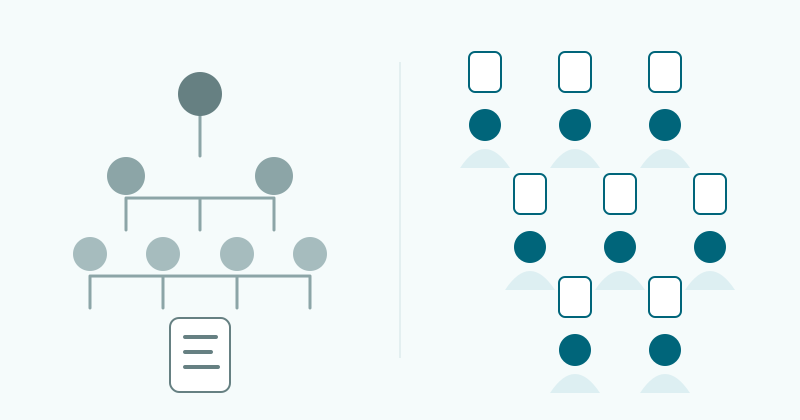
The third observation is that traditional media platforms were built on editorial processes that make scaling heavily dependent on increasing headcount. Meanwhile, the rise of social media allowed anyone to act as a publisher and compete with media outlets without paying for editorial operations.
As a result, traditional media platforms suffer from high costs and shrinking margins, struggling to reach consumers any better than a random person posting on X (Twitter).
For consumers, getting content has become easier but comes with obvious flaws: the content is repetitive, scattered across multiple platforms, and often lacks context or quality control.
As AI-generated content multiplies, this problem will inflate to the point where platforms, in their current form, will become practically unusable.
Our Vision for SRMED
From these three observations, our vision for SRMED emerged, and it rests on two main pillars:
A. Tech economics with institutional quality
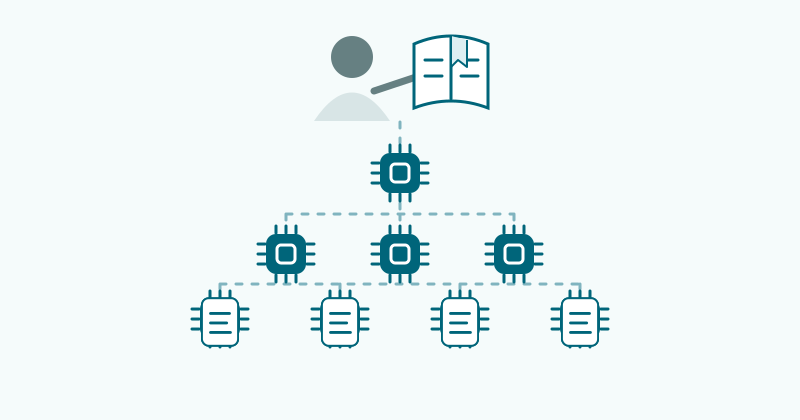
We want to leverage AI’s ability to produce at a low cost and high volume, but with institutional editorial standards. Our goal is to achieve the quality of major media outlets but with a smarter, highly scalable production infrastructure. The idea is to build SRMED as an AI-native platform from the ground up, where editorial standards aren't just a manual for humans to read, but are coded into the very programming and behavior of our AI agents.
Currently, AI cannot produce excellent, reliable content completely on its own; human intervention remains necessary. In phase one, our goal is to boost efficiency so that one person can accomplish the work of an entire team. The machine does the heavy lifting in research, drafting, and production, while human judgment handles the direction, standard-setting, and final decisions.
As AI capabilities evolve, the scope of this human intervention will definitely change. But no matter how advanced the tech gets, the sheer abundance of content will strip it of its standalone value. The real value will lie in the "institution" that stands behind the content and takes responsibility for it.
And that’s where SRMED comes in. Our vision goes way beyond just building a tech engine that spits out content. We are building a model that combines tech efficiency with institutional rigor. SRMED operates at the speed and scale of machines, but is governed by editorial standards that guarantee reliability—delivering content that users can actually depend on to understand the world.
B. Reinventing the content experience
The second part of our vision focuses on the consumption experience itself. In traditional media, content is usually a static piece broadcasted to a massive audience in a one-size-fits-all mold. The reason was simple: personalizing content for every single individual was impossible and far too expensive.
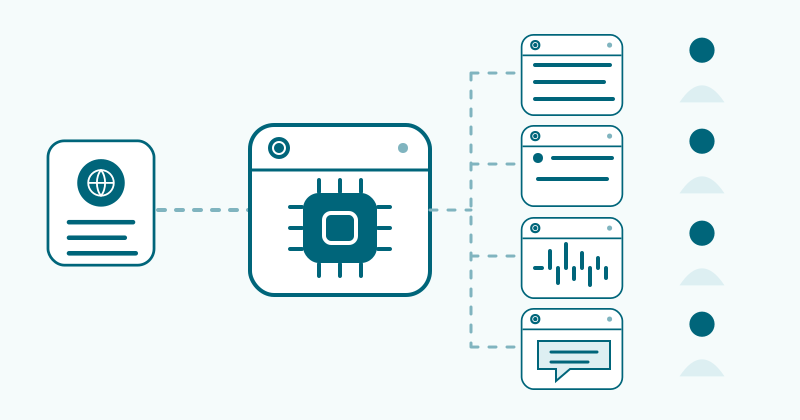
Today, AI flipped this equation, making highly customized content economically viable for the very first time. With this shift, media can finally move past the "one-size-fits-all" approach and evolve into an interactive relationship between humans and knowledge.
Because we are building SRMED on an AI-native infrastructure from day one, we can deliver content tailored to every person. Instead of a rigid template, users can interact with the material: they can ask for more details or a summary, change the format, or even ask follow-up questions. Our role isn't to build a massive library of static articles, but to provide a personalized interface that helps every individual explore and understand the world in a way that matches their knowledge level and preferences.
This personalization makes knowledge much more accessible and closer to people's lives, but it also comes with a clear risk: users isolating themselves in alternate versions of reality. That’s why, at SRMED, we draw a hard line between personalizing "how the truth is presented" and personalizing "the truth itself." Our guiding principle here is clear: Every user gets an explanation that suits them, but not a reality that suits them.
Conclusion
Our vision at SRMED is that AI will completely reshape the information landscape. In a world drowning in infinite content fighting for limited human attention, the real challenge won't be production. It will be filtering that content and knowing what deserves trust and attention. Our goal is to build an institution that merges machine efficiency with human responsibility, delivering knowledge through a personalized, interactive, and trustworthy experience.